Thursday, February 18, 2010

holy cross sermon for the last sunday after the epiphany, 2010


In the name of the Father, and of the Son, and of the Holy Spirit. Amen.

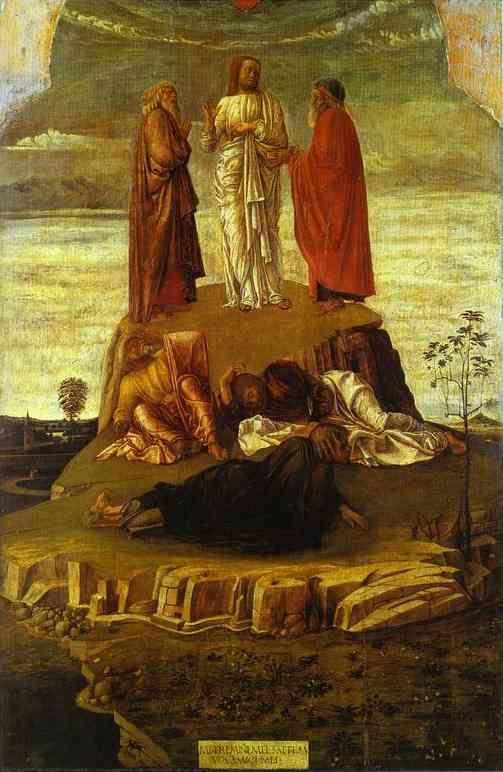
Today’s readings speak to us of the glory of the Lord, and of the encounter of the Lord’s disciples with his glory. The Gospel reading from St. Luke is the story of the Transfiguration of Jesus. What I am going to say is a little challenging, so put on your thinking caps. To get us thinking in the right direction, I am going to ask (and suggest and answer to) the question: why does the Lord hide his glory, revealing it only to a few, and in brief glimpses?

St. Luke says that Jesus goes up on a mountain to pray. This is something we see Jesus doing from time to time in the Gospels. Pope Benedict, in his book “Jesus of Nazareth” says that in these discreet Gospel episodes where we see Jesus up on a mountain, usually alone, in prayer – we catch a very brief, dim glimpse of the eternal communion of mutual delight that Jesus shares with the Father, which constitutes the very essence of God himself, the inner life of God, the love that St. John says God IS.

But in the story of the Transfiguration, Jesus does not go up onto a mountain “by himself” (cf. Matt. 14.23), but takes with him Peter, James, and John – the most inner circle of his disciples. And Luke says that “as he was praying, the appearance of his countenance was altered, and his raiment became dazzling white. And behold, two men talked with him, Moses and Elijah, who appeared in glory and spoke of his departure, which he was to accomplish at Jerusalem.” (Luke 9.29ff)

Here we have the crux of the Transfiguration story, from which it takes its name: “the appearance of [Jesus’] countenance was altered, and his raiment became dazzling white.” And Moses, the giver of the Law, and Elijah, representative of the prophetic witness of the Old Covenant, appear “in glory” and speak about Jesus’ death on the cross.

What is happening here? Each year, on the last Sunday before the beginning of Lent, the Church sets this text before us. This year we hear the version from St. Luke’s Gospel; last year we heard St. Mark’s version; and next year we will hear St. Matthew’s. What does the Church wish us to see in the Transfiguration on this last Sunday before the season of Lent?

St. Maximus the Confessor – a great teacher of the faith who lived in the 600’s – wrote about the message and meaning of the Transfiguration. He said (in Chapters on Knowledge):

To those who apply themselves with the utmost zeal to the divine Scriptures the Word as Lord appears under two forms: first, a general and public sight not reserved to a small number of which it is said, “He had no form or comeliness that we should look at him”; the second [form under which the Lord appears to those who apply themselves to the divine Scriptures] is more hidden, and accessible to a small number, to those who have already become as Peter, James, and John, the holy apostles before whom the Lord was transfigured in a glory overpowering the senses, in which "he is beautiful in appearance before the sons of men." Of these two forms, the first is fitting for beginners, the second is proportioned to those who have become perfect in knowledge, insofar as this is attainable. The former is the image of the first coming of the Lord to which the letter of the Gospel refers and which purifies by sufferings those who are in the stage of striving. The latter is a prefiguring of the second and glorious coming in which is understood the Spirit. It transfigures the [disciples] by wisdom with a view toward their deification. By this transfiguration of the Word in them, they behold with unveiled faces the Lord's glory.

This is what we are after. And this is the singular purpose of Lent. Our goal, the goal of all our spiritual striving, is the vision of the Lord with unveiled face, in his glory. We must desire this, because this is the experience of eternal blessedness. This is what will be “going on” in heaven: the unclouded perception of “the king in his beauty”. (Isaiah 33.17) And to discover a DESIRE for this in ourselves is to discover the cornerstone of salvation. And so we have to foster this desire in ourselves, and when we find it, even fleetingly, we have to run after it, nourish it, and coax it to grow. And this is the life of Christian devotion, and it is broadly speaking the point of Lent.

The perception of the “king in his beauty” is what the story of the Transfiguration is all about. Yet what is its “content”? What can we say about this vision? We may certainly say that it is the perception of the hidden glory of God – a glory that often – usually – remains hidden from many of Jesus’ own disciples, a glory that seems prone to be caught only in glimpses and for brief moments in this life, even for the greatest saints. But even if it is a glory that remains hidden, we can yet come to know it. For, as St. Paul says, “it is the God who said, ‘Let light shine out of darkness,’ who has shone in our hearts to give the light of the knowledge of the glory of God in the face of Christ.” (2 Cor. 4.6)

So why does God hide his glory? I think it is because of his great mercy toward us, because our nature could not bear the sudden disclosure of the Lord’s glory. We would be undone. We read in the Old Testament today of Moses coming down from Mt. Sinai, where he had encountered the Lord. Exodus says “when Aaron and all the people of Israel saw Moses, behold, the skin of his face shone, and they were afraid to come near him.” (Ex. 34.30) But when Moses was on the mountain, when he asked to see the Lord’s glory, the Lord told him “No,” – “I will make all my goodness pass before you, and will proclaim before you my name `The LORD'; and I will be gracious to whom I will be gracious, and will show mercy on whom I will show mercy. But,” he said, “you cannot see my face; for man shall not see me and live.” (Ex. 33.19f) And the Lord hid Moses in the cleft of the rock and made his glory to pass by, and allowed Moses to see him from behind.

So it remains for us. The Lord is with us even now, particularly in the tabernacle, veiled under the species of bread, yet we are separated even from his presence there by veils – literally: there is a veil over the ciborium that holds the consecrated hosts, and a veil that covers the tabernacle itself. The Lord “sits among us silently and secretly. When we approach Him, we know it only by faith; and when He manifests Himself to us, it is without our being able to realize to ourselves that manifestation.” (JH Newman in Sermon 1: Worship, A Preparation for Christ’s Coming)

Yet why? What is it about the Lord’s glory, and its sudden disclosure that means the undoing of worldly nature? Why can even the very pure only bear it, at best, in brief glimpses? Our Archbishop of Canterubry, Rowan Williams, has said “The hidden glory is not simply an arbitrary paradox or simply a consequence of the impossibility of God appearing as God in the created order: it is the outworking in finite form of the eternal self-yielding, self-hiding… of the Son before the Father, the Son who does not will to be 'visible' except as the living act of the Father.” (from Theology in the Face of Jesus) In other words, the disclosure of the Lord’s glory is the disclosure of the mystery of divine love. We can’t bear it because we are wrapped up in the world’s “system” of carefully managed egoism. To be ready to encounter the Lord’s glory we must first be absolutely willing to be “decentered” and dispossessed of self. And that prospect, if we are honest, is a terrifying one. It requires perfect trust.

As the believer begins to be free of self-absorption, s/he begins to see a little of what might be thinkable about a God wholly free of self-interest. Such a God is, on the one hand, free to be present without self-protection or reserve in any place, including the places most remote from 'heaven': he can be in the hell of suffering and abandonment without loss of self, since the divine self is utterly invested in the other; and on the other hand, such a God cannot be conceived as an eternal individual self, but as a life lived eternally in that 'investment' in the other. Thus the believer perceives what I have called the interiority and integrity of God, the resource and solidity of divine life: what is indestructibly solid in God is this life-in-the-other. To see the freedom of God to be in the cross is to see glory, because it is to see how God's utterly non-negotiable presence and action can be real in the physical body of the tortured and dying Jesus.

That is why the Lord’s transfiguration is perennially held before us on the last Sunday before Lent: because we are entering into the preparation that leads to the cross, and through it to Easter morning. If we are to reach Easter morning and its glory, we must understand that it is hidden behind “the covering that is cast over all peoples, the veil that is spread over all nations” (Isaiah 25.7), death itself – that God’s glory is to be found by, with, and in the tortured, dying, and dead Jesus.

As this realization is lived-out in the lives of the faithful, it is inevitably a painful and fearful process, but one nevertheless undergirded by a deep peace that transcends circumstance. At the end of today’s Gospel reading, we have an intimation of that: “a cloud came and overshadowed [the disciples]; and they were afraid as they entered the cloud. And a voice came out of the cloud, saying, ‘This is my Son, my Chosen; listen to him!’ And when the voice had spoken, Jesus was found alone.”

Having come to some knowledge of the glory of the Lord, let us stir up within ourselves a willingness to enter the cloud, trusting in the Lord’s mercy and loving-kindness, and let us attend to the voice of God in the darkness of the cloud bearing witness to his Son. And knowing that the cloud will dissipate and the darkness be turned to light, let us press on with boldness to find Jesus alone.

In the name of the Father, and of the Son, and of the Holy Spirit. Amen.

the ordination of a priest

Last Saturday I had the extraordinary privilege of preaching at the ordination to the priesthood of Fr. Michael Cover, a great friend from seminary. Here is what I said, and a picture of Fr. Michael at the moment he became a priest. My head is barely visible on the right.

In the name of the Father, and of the Son, and of the Holy Spirit. Amen.

First of all, I want to say what an honor it was for me when Michael asked if I would preach today – and I want to thank him, and to thank all of you.

I would like to begin by posing this question: what are priests for? Priests do all sorts of things, as I’ve learned in the few years that I have been one. Priests visit and minister to people at every stage of life, from the delivery room to the deathbed; they share in every joy and every sorrow of human existence. They visit nursing homes and prisons, they give out alms to the needy and food to the hungry, and sometimes they have the sad task of turning away the hungry and needy when the alms and the food run out. Priests pray and teach; they lead people in worshiping God; they counsel sinners. It never occurred to me as I was preparing for ordination, but priests also become intimately acquainted with the tediousness of life. Priests manage and administer and host. They make photocopies and prepare budgets; they cook meals and mix drinks; they sweep floors, arrange furniture, change light bulbs, polish silver – and a million other things that run the gamut from the sublime to the ridiculous.

These are all aspects of a normal priest’s existence. But what are priests FOR? After all, one doesn’t have to be a priest to visit the sick, to give out alms and food, to run photocopiers or mix drinks. Our Prayer Book also makes it clear that you don’t HAVE TO be a priest to anoint the sick, preside at a wedding, or hear a confession (though, its true, you must be a priest to absolve the penitent). Under some circumstances a deacon or a layman may even minister communion to the faithful. But there is one thing that only a priest may do, from the earliest days of Christianity to today, and that is the central fact and the central act of Christian life: only a priest may offer the Eucharistic Sacrifice of the Lord’s body and blood. THAT is what a priest is for. As Jesus said, to “do THIS in memory of me.” Dom Gregory Dix put it very well. He asked:

Was ever another command so obeyed? For century after century, spreading slowly to every continent and country and among every race on earth, this action has been done, in every conceivable human circumstance, for every conceivable human need from infancy and before it to extreme old age and after it, from the pinnacle of earthly greatness to the refuge of fugitives in the caves and dens of the earth. Men have found no better thing than this to do for kings at their crowning and for criminals going to the scaffold; for armies in triumph or for a bride and bridegroom in a little country church; for the proclamation of a dogma or for a good crop of wheat; for the wisdom of the Parliament of a mighty nation or for a sick old woman afraid to die; for a schoolboy sitting an examination or for Columbus setting out to discover America; for the famine of whole provinces or for the soul of a dead lover; in thankfulness because my father did not die of pneumonia; for a village headman much tempted to return to fetich because the yams had failed; because the Turk was at the gates of Vienna; for the repentance of Margaret; for the settlement of a strike; for a son for a barren woman; for Captain so-and-so wounded and prisoner of war; while the lions roared in the nearby amphitheatre; on the beach at Dunkirk; while the hiss of scythes in the thick June grass came faintly through the windows of the church; tremulously, by an old monk on the fiftieth anniversary of his vows; furtively, by an exiled bishop who had hewn timber all day in a prison camp near Murmansk; gorgeously, for the canonisation of S. Joan of Arc—one could fill many pages with the reasons why men have done this, and not tell a hundredth part of them. And best of all, week by week and month by month, on a hundred thousand successive Sundays, faithfully, unfailingly, across all the parishes of Christendom, the pastors have done this just to make the plebs sancta Dei—the holy common people of God.

THAT is what a priest is for. That is why his hands are anointed and that is the task to which he is set: as the Lord himself said, to “do THIS in memory of me.” And this action is the wellspring of grace from which flows everything else, every other facet of Christian ministry, for laymen and clergy alike: the acceptable offering of the Body and Blood of Jesus Christ to the Father for the remission of sins.

From this fact we may draw an important inference, and it is this: PRIESTHOOD DOES NOT BELONG TO MICHAEL COVER. It does not belong to Will Brown, or to Paul Lambert or to Pope Benedict. Priesthood belongs to Jesus Christ, and to him alone, because he alone among human beings offered himself acceptably to the Father – with every ounce of his being, with every breath he took, at every moment of his existence, the life and death of Jesus was perfectly conformed to his loving communion with the Father. And this means that he lived a life and died a death that was perfectly empowered by the Holy Spirit because, as St. Augustine says, “the Holy Spirit IS [that] unutterable communion of the Father and the Son…. [And] In order, therefore, that the communion of [Father and Son] may be signified from a name which is suitable to both, the Holy Spirit is called the gift of both. And this Trinity is one God, alone, good, great, eternal, omnipotent; itself its own unity, deity, greatness, goodness, eternity, omnipotence.” (De Trinitate, Book V, Ch. 11)

And this in turn is why we will invoke the Holy Spirit – when we sing Veni Creator Spiritus, and through the laying on of apostolic hands – because it is only by the Holy Spirit that “the love by which the Father loves the Son, and the Son loves the Father” (ibid. Book XV, Ch. 19) may be ineffably demonstrated; and THIS is the job of the priest at every mass: To show forth this eternal, divine, all-powerful love, which bubbles out (cf. Meister Eckhart) from the inner life of the Holy Trinity in an ecstasy of creation and redemption.

Priesthood belongs to Jesus Christ alone because Jesus Christ demonstrated this ecstatic, all-conquering love ALONE – for three hours, amid darkness and earthquake, at the place of a skull. In this place, on the highest, thinnest pinnacle of creation, Jesus, in his theanthropic solitude, cut off even from the tightest bonds of the love of his all-holy Mother, Jesus Christ broke the power of selfishness, envy, violence, corruption and rot; and there, from the depths of his woundedness, in water and blood, drove out the ruler of this world and demonstrated himself to be the earth’s Judge and the Lord of heaven. Here, on the nuptial bed of the cross, Jesus opened a new way for us, through his sacred heart, to the communion of mutual delight that is his alone, forever and by right, together with the Father.

It is this power acceptably to offer the body and blood of Jesus, which breaks down the dividing walls of hostility (Eph. 2.14) erected by human pride – it is this power of the cross that is being given to Michael today – the power to celebrate the memory of God’s only Son, to show forth the sacrifice of his death (cf. BCP p. 400) for the sins of the whole world, to proclaim his resurrection from the dead and his ascension in the flesh to the right hand of power. Today Michael is being given the power and the authority, in short, to celebrate the mass, to offer to the Father the substantial and inexhaustible contents of the mystery of our faith, the body and blood of his only Son – crucified, died, risen, glorified and reigning forever – and so perpetually to make known to the people who belong to God the all-conquering power of his love.

Michael, I want to leave you with three things. First, I want to exhort you to let your marriage be Eucharistic. Love your wife, and remember that your union with her, as the apostle says, demonstrates the mystery of our redemption (Eph. 5.25); that she shares your priesthood in a unique way, in virtue of the sacramental union of your flesh; and that there is perhaps no better way for you to demonstrate God’s love for his children than by your love for your wife. Let your marriage, your love for one another, be sustained and empowered by the marriage of divine nature and human nature in the one flesh of Jesus Christ, offered acceptably to the Father on the nuptial bed of the cross.

Secondly, I want to exhort you to let your whole priestly life be Eucharistic. Let everything you do – all the sublimities, tediousnesses and absurdities of priestly life and pastoral work – let it all be sustained and empowered by the body and blood of Jesus Christ, offered acceptably to the Father for the remission of sins. For the sake of Jesus, hold the people of God in your heart. Share their joys and allow yourself to be afflicted by their sufferings. Hold them all in prayer – the living and the dead. Remember them at God’s altar, breathe their names into the chalice of Christ’s blood. Live the difficult circumstances of God’s people as their brother; sincerely suffer them in your heart. Draw them, in the power of your Master, out of their anonymity and fear. Acquaint yourself with them and call them by name to walk in safety along the paths of life, to be found again when they become lost, to be loved, and to receive salvation as the supreme gift of God’s love. God has promised to his Church not hirelings, but shepherds after his own heart (Jer. 3.15). And his heart has been made known to us in the sacred heart of his only Son Jesus Christ, the Good Shepherd and our great High Priest. Allow your priestly life to be Eucharistic. (cf. JP2 in Pastores Dabo Vobis)

Thirdly, I want you always to remember that this mystery of God’s love is the TRUTH. It is the Gospel. It is to this truth that the whole economy of the Catholic Church bears witness. The blood of the martyrs cries out from the earth to proclaim this truth. When our Lord stood before Pilate he said, “For this I was born, and for this I have come into the world, to bear witness to the truth. Every one who is of the truth hears my voice.” (John 18.37) Attend to this truth. Listen for his voice in your study, in your life of prayer, in your adoration of our Lord’s sacramental presence. Give your voice, your pen, your hands, always in loving obedience and faithful service of this truth. Let your priestly ministry perpetually deepen into this truth. In this culture of clever incredulity, and in a Church that has in many ways conformed itself to this clever incredulity, suffer no denial of this truth. Allow yourself to be regarded as a fool for the sake of this truth. Live for this truth. Die for this truth.

And remember the words of the apostle, whose ministry you have now come by grace to share, who said: “I decided to know nothing among you except Jesus Christ and him crucified. And I was with you in weakness and in much fear and trembling; and my speech and my message were not in plausible words of wisdom, but in demonstration of the Spirit and of power, that your faith might not rest in the wisdom of men but in the power of God.” (1 Cor. 2.2ff)

So to God most holy in his divine majesty of trinity-in-unity, to Jesus Christ our Lord and God, made man and crucified for us, to blessed Mary, ever-virgin, from whose glorious purity he took flesh, and to the entire company of the saints in heaven, be everlasting praise, honor, power, and glory, from every creature on earth, and unto us sinners may there be full remission of all our sins, through the blood of Christ’s cross, throughout all ages, world without end. Amen.

Tuesday, January 26, 2010

holy cross sermon for year c epiphany 3 / January 24 2010

In the name of the Father, and of the Son, and of the Holy Spirit. Amen.

“If one member suffers, all suffer together with it; if one member is honored, all rejoice together with it. Now you are the body of Christ and individually members of it.” (1 Cor. 12.27)

In today’s epistle reading, St. Paul expounds the principle of interdependence that is a hallmark of life in the communion of Christ. This is a theme that is currently being taken up, in a very public way, by the Anglican Communion – the worldwide communion of churches of which the Episcopal Church in the USA and the Diocese of Dallas (and therefore Holy Cross, and therefore you and I) are members.

On Sundays before mass here at Holy Cross, in the parish hall, we are looking at the text of the recently-released Anglican Covenant, which attempts to enunciate in a concrete way some the principles of interdependence to which St. Paul speaks throughout his epistles, and particularly in 1 Corinthians, as we have heard today. Anglicans have not done a particularly good job of living-out these principles in recent years, and our very public – and very scandalous – divisions and lawsuits are evidence of that failure.

The church at Corinth, in Paul’s day, suffered from divisions and conflict too, and therefore Paul’s letters to the Corinthians make particularly helpful reading for us. In the opening verses of the section of 1 Corinthians we heard today, Paul reminds us of the objective unity that we share in the Body of Christ: “For just as the body is one and has many members, and all the members of the body, though many, are ONE body, so it is with Christ. For by ONE Spirit we were all baptized into ONE body -- Jews or Greeks, slaves or free -- and all were made to drink of ONE Spirit.” (1 Cor. 12.12-13)

The unity of the one Catholic Church – and our “commUNION” in that Body – has its source in the inner life of God. As we say in the Nicene Creed: “We believe in ONE God…” And this solitary fact is what separated the earliest Christians, and our elder brothers in faith, the Jews, from the majority of the world’s peoples, who believed in many gods. Elsewhere in 1 Corinthians Paul makes this point more explicitly: “for us there is one God, the Father, from whom are all things and for whom we exist, and one Lord, Jesus Christ, through whom are all things and through whom we exist.” (1 Cor. 8.6) We have our very being – our existence – only from and in the one God. And our calling, our destiny, our salvation, consists in our emergent conformity to the likeness of God in this and every other respect – a conformity that is God’s gift to us through the outpouring of the one Holy Spirit of God.

The very first paragraph of the Anglican Covenant makes this point explicitly, and points out that this emergent conformity to the likeness of the one God is not an abstraction. It takes concrete and tangible form in the life of the Church. Our interdependence in the communion of the Church is therefore not something coincidental; it is not merely a pleasant byproduct of being a Christian, something that just happens, expressing itself in an ability to get along with one another. It is rather a discipline, something we must work-at as individuals and groups within the one Body. It is a task that is not always pleasant, but requires humility, patience, longsuffering, forbearance, and a willingness now always to get one’s own way. But this work is important because it is the only way by which we approach salvation itself – the beatific communion that is nothing less and nothing other than the inner life of God himself.

The Anglican Covenant, drawing, among other things, on 1 Corinthians, puts it this way:

God has called us into communion in Jesus Christ (1 Cor. 1.9). This communion has been “revealed to us” by the Son as being the very divine life of God the Trinity…. St John makes it clear that the communion of life in the Church participates in the communion which is the divine life itself, the life of the Trinity. This life is not a reality remote from us, but one that has been “seen” and “testified to” by the apostles and their followers: “for in the communion of the Church we share in the divine life”[1]. This life of the One God, Father, Son, and Holy Spirit, shapes and displays itself through the very existence and ordering of the Church.

Therefore, to return to the biotic metaphor St. Paul uses in today’s epistle: no part of the body can say to another, “I have no need of you.” (1 Cor. 12.21) To do so is to turn away from the only way to the everlasting life that is the one God’s proper self-possession, and his gift to us in his one Son, Jesus Christ.

After having said that our interdependence in the communion Christ’s Body is no mere abstraction, it begins to sound rather abstract. So what does it mean, in concrete terms? It means self-emptying humility – and so it means, again, Jesus Christ, the only Son of God, who emptied himself in great humility, and empowers us to do the same. Again concretely, this means that we must be willing to forsake anything and everything for the sake of Jesus and the communion that is ours in him. As he himself has said, “whoever of you does not renounce all that he has cannot be my disciple.” (Luke 14.33)

It is important to say that when the Lord says that we must renounce “all” things, he means just that. We must be willing to leave everything to follow him to the communion of divine life that is our inheritance in him. This means, first of all, that we must renounce sin. But the point is that any created thing may become sin if we allow it to become an impediment to our communion in Christ. At every level of our life together, we must be willing to abandon things we hold dear – possessions and even relationships, and particularly our opinions and agendas – for the sake of our divine calling to communion in Christ.

It was the Corinthians’ refusal to do this that earned them a very stern rebuke from St. Paul with respect to their presuming to approach the blessed sacrament– the source and summit of our communion in Christ – in a state of selfish alienation from one another. Paul says, “Let a man examine himself, and so eat of the bread and drink of the cup. For any one who eats and drinks WITHOUT DISCERNING THE BODY eats and drinks judgment upon himself. That is why many of you are weak and ill, and some have died. But if we judged ourselves truly, we should not be judged. But when we are judged by the Lord, we are chastened so that we may not be condemned along with the world. So then, my brethren, when you come together to eat, wait for one another…” (1 Cor. 11.28ff)

The do-it-yourself culture of self-sufficiency and rugged individualism on which America feeds, runs absolutely counter to the teaching of the Gospel on this point (and many others). We will be saved TOGETHER, or we will not be saved. And the culture of American self-sufficiency manifests itself under pious, religious guises as well: in the American tendency to “church shop” – to look for a community of faith that meshes with our own opinions and agendas or aesthetic sensibilities; or as in the case the Episcopal Church generally, to cling more tenaciously to our own understanding of justice (or this or that) than we cling to the brothers and sisters to whom God has called us into communion. But let us be clear: there is no justice apart from communion; there is no peace apart from communion; there is no goodness apart from communion; there is no SALVATION apart from communion – because all of these things come to us by, with, and in Jesus Christ alone, because they belong properly and only to him who has received them from his Father.

In the communion of God’s inner-life, bestowed on us in Jesus Christ, and made living and active by the power of the Holy Spirit, we learn the difficult lesson that communion is a discipline of love, and that, as St. Paul says, “love is patient and kind; love is not jealous or boastful; it is not arrogant or rude. Love does not insist on its own way; it is not irritable or resentful; it does not rejoice at wrong, but rejoices in the right. Love bears all things, believes all things, hopes all things, endures all things.” (1 Cor. 13.4ff) And so must we, for the sake of love, and so for the sake of our communion.

In the name of the Father, and of the Son, and of the Holy Spirit. Amen.

holy cross sermon for year c epiphay 2 / january 17 2010

In the name of the Father, and of the Son, and of the Holy Spirit. Amen.

Today’s Gospel speaks to us of the Lord’s first miracle at a wedding in the town of Cana, in Galilee. This story has been cited in the Anglican marriage ritual for almost 500 years. In the marriage ritual in the definitive edition of the Book of Common Prayer – that of 1662 – the priest says to the congregation that marriage “is an honourable estate, instituted of God in the time of man's innocency, signifying unto us the mystical union that is betwixt Christ and his Church; which holy estate Christ adorned and beautified with his presence, and first miracle that he wrought, in Cana of Galilee.” We teach therefore that Christ’s presence and first miracle at a wedding renew, fulfill, and make holy the intentional joining-together of men and women in marriage, which God ordained and established in the creation of the world.

This significance of the wedding-at-cana story resides on the surface of Scripture, as it were, and is discerned through, as is often the case, through the lens of the how the Church prays liturgically. That is to say: the hallowing of Christian marriage by Christ is there in Scripture, but reading Scripture through the lens of the Church’s common prayer enables us to see what Scripture means. This is often the way it works.

I would like to talk about three other aspects of the wedding-at-cana story: Firstly as a manifestation of Christ’s power; secondly the role of Mary in the story and what we can learn from her role; and thirdly how this story points to Christ himself, the bridegroom of our souls.

First, the Gospel reading is perfectly explicit that this story relates a miracle: Jesus turns water into wine. But this is not a magic trick, and Jesus is not a magician. Today’s Gospel concludes by saying that by means of this miracle – or “sign” as St. John calls it – Jesus “manifested his glory; and his disciples believed in him.” (John 2.11)

Jesus’ sign is a multivalent, prophetic, and poetic thing; and by working this sign, Jesus invites those with eyes to see and ears to hear to believe in him, to understand that he is the anointed of God, who has come to save those who believe in his name: he manifests his glory to his disciples.

Throughout the Old Testament, the prophets had used an abundance of wine as a symbol marking God’s promised deliverance, which was to be accomplished by his anointed – “he who is coming into the world” (John 11.27). The Lord speaks through the prophet Joel, saying “you shall know that I am the LORD your God, who dwell in Zion, my holy mountain. And Jerusalem shall be holy and strangers shall never again pass through it. And in that day the mountains shall drip sweet wine” (Joel 3.17-18); likewise Amos says, “Behold, the days are coming, says the LORD, when the plowman shall overtake the reaper and the treader of grapes him who sows the seed; the mountains shall drip sweet wine, and all the hills shall flow with it” (Amos 9.13).

And so Jesus’ emergence onto the seen, the first manifestation of his glory, is in the abundance of wine foretold by the prophets as a sign of God’s vindication of his people. “…And his disciples believed in him.”

Secondly, we ought also to note who instigates this manifestation of Christ’s glory. The Gospel says “…the mother of Jesus was there… [and] when the wine failed, the mother of Jesus said to him, ‘They have no wine.’” (vv. 1&3) It is Mary who presents the situation’s deficit to Jesus, because of her great faith in the promises of God, fulfilled in her divine Son. And here we should discern a deeper truth: that because Jesus takes flesh from the Virgin – because he takes his human nature from her – it is she who presents to him our brokennesses and deficiencies, in whatever particular form they take in each of our lives. And when we find our humanness depleted, as each of us do from time to time and in a myriad of ways, we should not hesitate to bring our weariness to the Virgin Mother.

Why is this so? Because when we grow weary with toil, when we are hard-pressed with affliction, there is very often a corresponding temptation to unbelief. Satan whispers in our ear at such times that God does not see, or that he does not care, or that he does not exist. The problems with which we are beset as a result of living a human life in this world are accompanied by a deficit of faith as well. But Jesus said “Truly, I say to you, if you have faith and never doubt… [then] even if you say to this mountain, `Be taken up and cast into the sea,' it will be done” (Matthew 21.21); “if you have faith… nothing will be impossible to you” (Matthew 17.20).

When we grow weary and our faith falters, we should fly to Mary and ride the coat-tails of her faith, the faith of the one who, as Scripture says, “BELIEVED that there would be a fulfilment of what was spoken… from the Lord” (Luke 1.45) – the therefore who brings who presents our broken humanity to God, but who does so with faith in his power to heal.

When we speak the name of Mary with devotion, she speaks the name of Jesus in return. And on this score, we should notice her final words in this Gospel reading – her final words to “the servants”, but also to us: “Do whatever [Jesus] tells you” (John 2.5). We must be not only hearers of God’s word, but doers (James 1.22). So will we bring ourselves to a place where the glory of Christ can be manifest to us and in us as well.

Thirdly, lastly, and most importantly, this is a love story, a marriage story; and as such it points to the reality that conjugal love has represented from the creation of the world: the marriage of divine nature and human nature that took place in the incarnation of the Word, the person of Jesus himself. In him God took to himself a bride – our broken humanness. In him God loved us. In him God lived and died and rose again for us.

Saint Augustine says, “What marvel, if [Jesus] went to that house to a marriage, Who came into this world to a marriage. For here [Jesus] has his spouse whom he redeemed with his own blood, to whom he gave the pledge of the Spirit, and whom he united to himself in the womb of the Virgin. For the Word is the Bridegroom, and human flesh the bride, and both together are one Son of God and Son of man. [The] womb of the Virgin Mary is his chamber, from which he went for as a bridegroom.”

Therefore let us be friends of the Bridegroom. Let us, with St. John the Baptist, stand and hear him, rejoicing greatly at his voice, that this joy of ours may be full. Let our apprehension of the Lord be accompanied and assisted by the faith of Mary. Let us, at her command, with the servants of the feast, “do whatever Jesus tells us” – that we may be disciples to whom he manifests his glory, empowered to go into the world believing in him; so that as the bridegroom rejoices over the bride, so may our God rejoice over us (cf. Isaiah 62.5).

In the name of the Father, and of the Son, and of the Holy Spirit. Amen.

Tuesday, January 19, 2010

holy cross sermon for the second sunday after the epiphany / january 17 2010

In the name of the Father, and of the Son, and of the Holy Spirit. Amen.

Today’s Gospel speaks to us of the Lord’s first miracle at a wedding in the town of Cana, in Galilee. This story has been cited in the Anglican marriage ritual for almost 500 years. In the marriage ritual in the definitive edition of the Book of Common Prayer – that of 1662 – the priest says to the congregation that marriage “is an honourable estate, instituted of God in the time of man's innocency, signifying unto us the mystical union that is betwixt Christ and his Church; which holy estate Christ adorned and beautified with his presence, and first miracle that he wrought, in Cana of Galilee.” We teach therefore that Christ’s presence and first miracle at a wedding renew, fulfill, and make holy the intentional joining-together of men and women in marriage, which God ordained and established in the creation of the world.

This significance of the wedding-at-cana story resides on the surface of Scripture, as it were, and is discerned through, as is often the case, through the lens of the how the Church prays liturgically. That is to say: the hallowing of Christian marriage by Christ is there in Scripture, but reading Scripture through the lens of the Church’s common prayer enables us to see what Scripture means. This is often the way it works.

I would like to talk about three other aspects of the wedding-at-cana story: Firstly as a manifestation of Christ’s power; secondly the role of Mary in the story and what we can learn from her role; and thirdly how this story points to Christ himself, the bridegroom of our souls.

First, the Gospel reading is perfectly explicit that this story relates a miracle: Jesus turns water into wine. But this is not a magic trick, and Jesus is not a magician. Today’s Gospel concludes by saying that by means of this miracle – or “sign” as St. John calls it – Jesus “manifested his glory; and his disciples believed in him.” (John 2.11)

Jesus’ sign is a multivalent, prophetic, and poetic thing; and by working this sign, Jesus invites those with eyes to see and ears to hear to believe in him, to understand that he is the anointed of God, who has come to save those who believe in his name: he manifests his glory to his disciples.

Throughout the Old Testament, the prophets had used an abundance of wine as a symbol marking God’s promised deliverance, which was to be accomplished by his anointed – “he who is coming into the world” (John 11.27). The Lord speaks through the prophet Joel, saying “you shall know that I am the LORD your God, who dwell in Zion, my holy mountain. And Jerusalem shall be holy and strangers shall never again pass through it. And in that day the mountains shall drip sweet wine” (Joel 3.17-18); likewise Amos says, “Behold, the days are coming, says the LORD, when the plowman shall overtake the reaper and the treader of grapes him who sows the seed; the mountains shall drip sweet wine, and all the hills shall flow with it” (Amos 9.13).

And so Jesus’ emergence onto the seen, the first manifestation of his glory, is in the abundance of wine foretold by the prophets as a sign of God’s vindication of his people. “…And his disciples believed in him.”

Secondly, we ought also to note who instigates this manifestation of Christ’s glory. The Gospel says “…the mother of Jesus was there… [and] when the wine failed, the mother of Jesus said to him, ‘They have no wine.’” (vv. 1&3) It is Mary who presents the situation’s deficit to Jesus, because of her great faith in the promises of God, fulfilled in her divine Son. And here we should discern a deeper truth: that because Jesus takes flesh from the Virgin – because he takes his human nature from her – it is she who presents to him our brokennesses and deficiencies, in whatever particular form they take in each of our lives. And when we find our humanness depleted, as each of us do from time to time and in a myriad of ways, we should not hesitate to bring our weariness to the Virgin Mother.

Why is this so? Because when we grow weary with toil, when we are hard-pressed with affliction, there is very often a corresponding temptation to unbelief. Satan whispers in our ear at such times that God does not see, or that he does not care, or that he does not exist. The problems with which we are beset as a result of living a human life in this world are accompanied by a deficit of faith as well. But Jesus said “Truly, I say to you, if you have faith and never doubt… [then] even if you say to this mountain, `Be taken up and cast into the sea,' it will be done” (Matthew 21.21); “if you have faith… nothing will be impossible to you” (Matthew 17.20).

When we grow weary and our faith falters, we should fly to Mary and ride the coat-tails of her faith, the faith of the one who, as Scripture says, “BELIEVED that there would be a fulfilment of what was spoken… from the Lord” (Luke 1.45) – the therefore who brings who presents our broken humanity to God, but who does so with faith in his power to heal.

When we speak the name of Mary with devotion, she speaks the name of Jesus in return. And on this score, we should notice her final words in this Gospel reading – her final words to “the servants”, but also to us: “Do whatever [Jesus] tells you” (John 2.5). We must be not only hearers of God’s word, but doers (James 1.22). So will we bring ourselves to a place where the glory of Christ can be manifest to us and in us as well.

Thirdly, lastly, and most importantly, this is a love story, a marriage story; and as such it points to the reality that conjugal love has represented from the creation of the world: the marriage of divine nature and human nature that took place in the incarnation of the Word, the person of Jesus himself. In him God took to himself a bride – our broken humanness. In him God loved us. In him God lived and died and rose again for us.

Saint Augustine says, “What marvel, if [Jesus] went to that house to a marriage, Who came into this world to a marriage. For here [Jesus] has his spouse whom he redeemed with his own blood, to whom he gave the pledge of the Spirit, and whom he united to himself in the womb of the Virgin. For the Word is the Bridegroom, and human flesh the bride, and both together are one Son of God and Son of man. [The] womb of the Virgin Mary is his chamber, from which he went for as a bridegroom.”

Therefore let us be friends of the Bridegroom. Let us, with St. John the Baptist, stand and hear him, rejoicing greatly at his voice, that this joy of ours may be full. Let our apprehension of the Lord be accompanied and assisted by the faith of Mary. Let us, at her command, with the servants of the feast, “do whatever Jesus tells us” – that we may be disciples to whom he manifests his glory, empowered to go into the world believing in him; so that as the bridegroom rejoices over the bride, so may our God rejoice over us (cf. Isaiah 62.5).

In the name of the Father, and of the Son, and of the Holy Spirit. Amen.

Tuesday, December 22, 2009

advent responsory

I look from afar: and lo, I see the power of God coming, and a cloud covering the whole earth. Go ye out to meet him and say: tell us, art thou he that should come to reign over thy people Israel?

High and low, rich and poor, One with another, go ye out to meet him and say: Hear, O thou shepherd of Israel, thou that leadest Joseph like a sheep:

Tell us, art thou he that should come?

Stir up thy strength, O Lord, and come to reign over thy people Israel.

Glory be to the Father, and to the Son, and to the Holy Ghost.

I look from afar: and lo, I see the power of God coming, and a cloud covering the whole earth. Go ye out to meet him and say: tell us, art thou he that should come to reign over thy people Israel?

Saturday, December 12, 2009

from pope benedict's encyclical spe salvi - saved through hope


We can try to limit suffering, to fight against it, but we cannot eliminate it. It is when we attempt to avoid suffering by withdrawing from anything that might involve hurt, when we try to spare ourselves the effort and pain of pursuing truth, love, and goodness, that we drift into a life of emptiness, in which there may be almost no pain, but the dark sensation of meaninglessness and abandonment is all the greater. It is not by sidestepping or fleeing from suffering that we are healed, but rather by our capacity for accepting it, maturing through it and finding meaning through union with Christ, who suffered with infinite love. In this context, I would like to quote a passage from a letter written by the Vietnamese martyr Paul Le-Bao-Tinh († 1857) which illustrates this transformation of suffering through the power of hope springing from faith. “I, Paul, in chains for the name of Christ, wish to relate to you the trials besetting me daily, in order that you may be inflamed with love for God and join with me in his praises, for his mercy is for ever (Ps 136 [135]). The prison here is a true image of everlasting Hell: to cruel tortures of every kind—shackles, iron chains, manacles—are added hatred, vengeance, calumnies, obscene speech, quarrels, evil acts, swearing, curses, as well as anguish and grief. But the God who once freed the three children from the fiery furnace is with me always; he has delivered me from these tribulations and made them sweet, for his mercy is for ever. In the midst of these torments, which usually terrify others, I am, by the grace of God, full of joy and gladness, because I am not alone —Christ is with me ... How am I to bear with the spectacle, as each day I see emperors, mandarins, and their retinue blaspheming your holy name, O Lord, who are enthroned above the Cherubim and Seraphim? (cf. Ps 80:1 [79:2]). Behold, the pagans have trodden your Cross underfoot! Where is your glory? As I see all this, I would, in the ardent love I have for you, prefer to be torn limb from limb and to die as a witness to your love. O Lord, show your power, save me, sustain me, that in my infirmity your power may be shown and may be glorified before the nations ... Beloved brothers, as you hear all these things may you give endless thanks in joy to God, from whom every good proceeds; bless the Lord with me, for his mercy is for ever ... I write these things to you in order that your faith and mine may be united. In the midst of this storm I cast my anchor towards the throne of God, the anchor that is the lively hope in my heart”[28]. This is a letter from “Hell”. It lays bare all the horror of a concentration camp, where to the torments inflicted by tyrants upon their victims is added the outbreak of evil in the victims themselves, such that they in turn become further instruments of their persecutors' cruelty. This is indeed a letter from Hell, but it also reveals the truth of the Psalm text: “If I go up to the heavens, you are there; if I sink to the nether world, you are present there ... If I say, ‘Surely the darkness shall hide me, and night shall be my light' —for you darkness itself is not dark, and night shines as the day; darkness and light are the same” (Ps 139 [138]:8-12; cf. also Ps 23 [22]:4). Christ descended into “Hell” and is therefore close to those cast into it, transforming their darkness into light. Suffering and torment is still terrible and well- nigh unbearable. Yet the star of hope has risen—the anchor of the heart reaches the very throne of God. Instead of evil being unleashed within man, the light shines victorious: suffering—without ceasing to be suffering—becomes, despite everything, a hymn of praise.